
Starmaster

De Activision

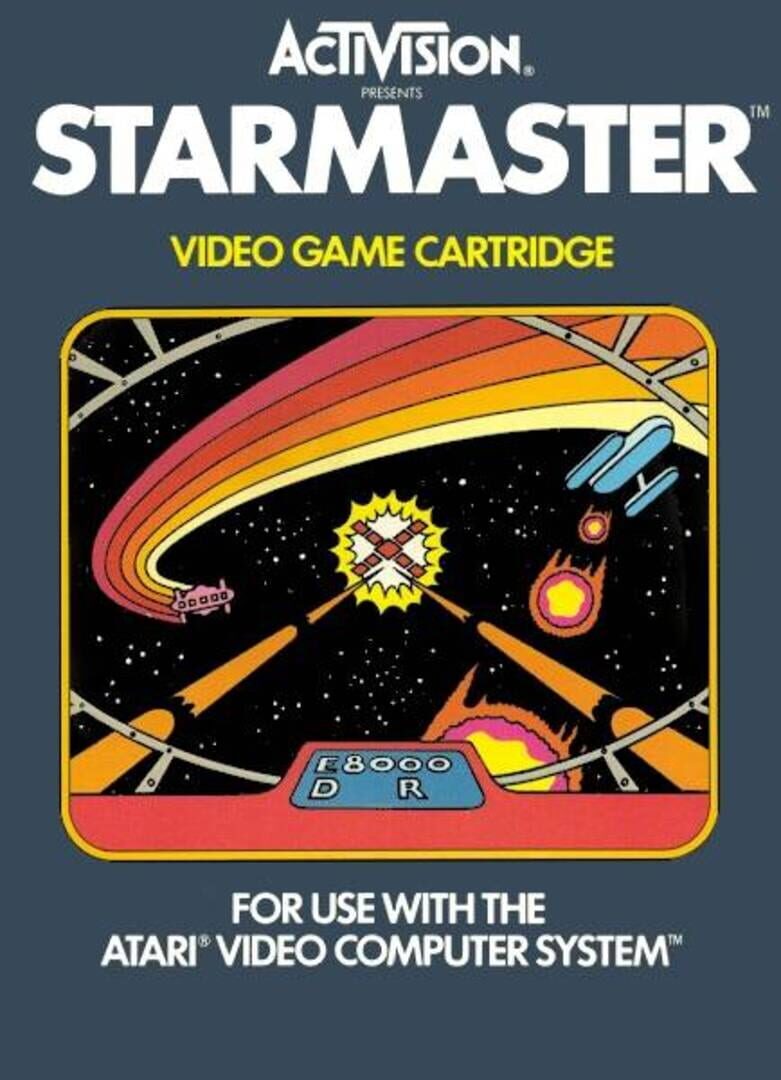
In the game the player pilots a starfighter, with the purpose of destroying a number of enemy ships before they destroy four friendly starbases. Gameplay is presented mostly in first person cockpit view, which is achieved with surprisingly good effect given the 2600's primitive graphics capabilities. The starfighter carries laser weapons, shields, and a faster-than-light drive. The fighter also carries a limited energy supply, which is drained by firing the lasers, being hit by enemy fire, warping, or simply flying around. If the ship's energy drops to zero it is destroyed, and the game ends. Enemy fire can knock out the fighter's subsystems (such as weapons) on top of draining energy. The game "universe" is a square-shaped galaxy mapped into a grid of 36 sectors. Each sector can be home to some enemy ships, a starbase, both, or nothing. The player "warps" the fighter to a sector to engage enemy ships; once they are all destroyed, the player moves on to another. The player can also warp to a sector with a starbase, and dock with it (a rather tricky process) to replenish energy and repair damaged subsystems. Enemy ships in turn maneuver through the galaxy as they home in to destroy the starbases. The game is won when all enemy ships are destroyed, or lost if either the player's fighter or all four starbases are destroyed.

Starmaster

Starmaster

In the game the player pilots a starfighter, with the purpose of destroying a number of enemy ships before they destroy four friendly starbases. Gameplay is presented mostly in first person cockpit view, which is achieved with surprisingly good effect given the 2600's primitive graphics capabilities. The starfighter carries laser weapons, shields, and a faster-than-light drive. The fighter also carries a limited energy supply, which is drained by firing the lasers, being hit by enemy fire, warping, or simply flying around. If the ship's energy drops to zero it is destroyed, and the game ends. Enemy fire can knock out the fighter's subsystems (such as weapons) on top of draining energy. The game "universe" is a square-shaped galaxy mapped into a grid of 36 sectors. Each sector can be home to some enemy ships, a starbase, both, or nothing. The player "warps" the fighter to a sector to engage enemy ships; once they are all destroyed, the player moves on to another. The player can also warp to a sector with a starbase, and dock with it (a rather tricky process) to replenish energy and repair damaged subsystems. Enemy ships in turn maneuver through the galaxy as they home in to destroy the starbases. The game is won when all enemy ships are destroyed, or lost if either the player's fighter or all four starbases are destroyed.
Starmaster

Starmaster

In the game the player pilots a starfighter, with the purpose of destroying a number of enemy ships before they destroy four friendly starbases. Gameplay is presented mostly in first person cockpit view, which is achieved with surprisingly good effect given the 2600's primitive graphics capabilities. The starfighter carries laser weapons, shields, and a faster-than-light drive. The fighter also carries a limited energy supply, which is drained by firing the lasers, being hit by enemy fire, warping, or simply flying around. If the ship's energy drops to zero it is destroyed, and the game ends. Enemy fire can knock out the fighter's subsystems (such as weapons) on top of draining energy. The game "universe" is a square-shaped galaxy mapped into a grid of 36 sectors. Each sector can be home to some enemy ships, a starbase, both, or nothing. The player "warps" the fighter to a sector to engage enemy ships; once they are all destroyed, the player moves on to another. The player can also warp to a sector with a starbase, and dock with it (a rather tricky process) to replenish energy and repair damaged subsystems. Enemy ships in turn maneuver through the galaxy as they home in to destroy the starbases. The game is won when all enemy ships are destroyed, or lost if either the player's fighter or all four starbases are destroyed.

Sobre o jogo

In the game the player pilots a starfighter, with the purpose of destroying a number of enemy ships before they destroy four friendly starbases. Gameplay is presented mostly in first person cockpit view, which is achieved with surprisingly good effect given the 2600's primitive graphics capabilities. The starfighter carries laser weapons, shields, and a faster-than-light drive. The fighter also carries a limited energy supply, which is drained by firing the lasers, being hit by enemy fire, warping, or simply flying around. If the ship's energy drops to zero it is destroyed, and the game ends. Enemy fire can knock out the fighter's subsystems (such as weapons) on top of draining energy. The game "universe" is a square-shaped galaxy mapped into a grid of 36 sectors. Each sector can be home to some enemy ships, a starbase, both, or nothing. The player "warps" the fighter to a sector to engage enemy ships; once they are all destroyed, the player moves on to another. The player can also warp to a sector with a starbase, and dock with it (a rather tricky process) to replenish energy and repair damaged subsystems. Enemy ships in turn maneuver through the galaxy as they home in to destroy the starbases. The game is won when all enemy ships are destroyed, or lost if either the player's fighter or all four starbases are destroyed.

Lançamento
1982
Plataformas

Sobre o jogo

In the game the player pilots a starfighter, with the purpose of destroying a number of enemy ships before they destroy four friendly starbases. Gameplay is presented mostly in first person cockpit view, which is achieved with surprisingly good effect given the 2600's primitive graphics capabilities. The starfighter carries laser weapons, shields, and a faster-than-light drive. The fighter also carries a limited energy supply, which is drained by firing the lasers, being hit by enemy fire, warping, or simply flying around. If the ship's energy drops to zero it is destroyed, and the game ends. Enemy fire can knock out the fighter's subsystems (such as weapons) on top of draining energy. The game "universe" is a square-shaped galaxy mapped into a grid of 36 sectors. Each sector can be home to some enemy ships, a starbase, both, or nothing. The player "warps" the fighter to a sector to engage enemy ships; once they are all destroyed, the player moves on to another. The player can also warp to a sector with a starbase, and dock with it (a rather tricky process) to replenish energy and repair damaged subsystems. Enemy ships in turn maneuver through the galaxy as they home in to destroy the starbases. The game is won when all enemy ships are destroyed, or lost if either the player's fighter or all four starbases are destroyed.

Média de Avaliação
N/A
1★
5★
Jogaram
0
Jogando
0
Pausados
0
Quero jogar
0
Dropados
0
0
Listas
0
Avaliações
0
Likes
Duração média para concluir apenas a história principal.
--
Principal
Duração média para terminar a campanha e missões extras.
--
Extras
Duração média para atingir 100% (conquistas e segredos).
3h
100%

Jogos relacionados

Avaliações
Opiniões recentes da comunidade sobre este jogo.
Ainda não há avaliações para este jogo. Seja o primeiro a avaliar!