
Munch Man

De Texas Instruments Incorporated

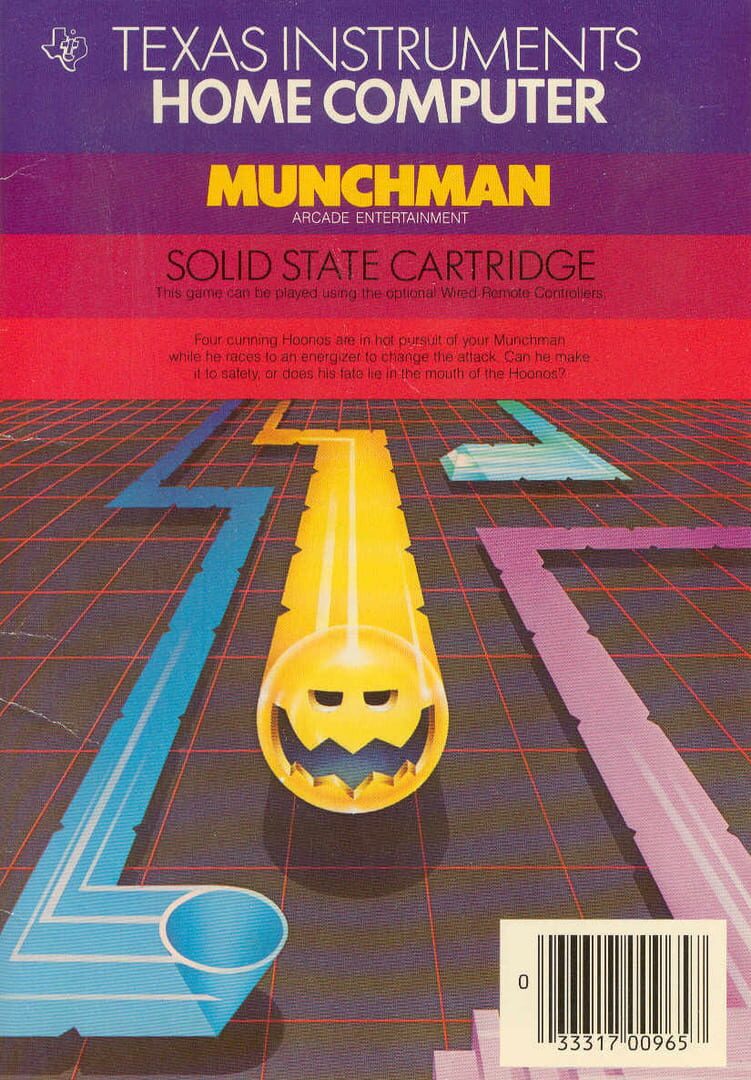
Munch Man is a video game written by Jim Dramis for the Texas Instruments TI-99/4A home computer and published as a cartridge by Texas Instruments in 1982. Based on Namco's Pac-Man, Munch Man includes several variations that alter and enhance gameplay. Dramis later wrote Parsec for the TI-99/4A. The player controls the Munch Man using either the keyboard or joystick. Like Pac-Man, the goal of a level is to visit every part of the maze, but instead of eating dots the player fills the maze with a chain pattern. Four Hoonos (the equivalent of Pac-Man ghosts) attempt to thwart Munch Man's efforts to complete his mission. However, Munch Man always has his "Energizer" (the equivalent of a Pac-Man power pill) which gives Munch Man the ability to devour the Hoonos. The game ends when the player's lives are depleted. In level 20, 40, and 60, the maze is invisible and there are no chains. Instead, Munch Man must eat all the TI logos in the invisible maze. This gives the odd effect of showcasing the maze at first, but slowly hiding the maze as the player removes the indications of the maze paths by eating the TI logos.

Munch Man

Munch Man

Munch Man is a video game written by Jim Dramis for the Texas Instruments TI-99/4A home computer and published as a cartridge by Texas Instruments in 1982. Based on Namco's Pac-Man, Munch Man includes several variations that alter and enhance gameplay. Dramis later wrote Parsec for the TI-99/4A. The player controls the Munch Man using either the keyboard or joystick. Like Pac-Man, the goal of a level is to visit every part of the maze, but instead of eating dots the player fills the maze with a chain pattern. Four Hoonos (the equivalent of Pac-Man ghosts) attempt to thwart Munch Man's efforts to complete his mission. However, Munch Man always has his "Energizer" (the equivalent of a Pac-Man power pill) which gives Munch Man the ability to devour the Hoonos. The game ends when the player's lives are depleted. In level 20, 40, and 60, the maze is invisible and there are no chains. Instead, Munch Man must eat all the TI logos in the invisible maze. This gives the odd effect of showcasing the maze at first, but slowly hiding the maze as the player removes the indications of the maze paths by eating the TI logos.
Munch Man

Munch Man

Munch Man is a video game written by Jim Dramis for the Texas Instruments TI-99/4A home computer and published as a cartridge by Texas Instruments in 1982. Based on Namco's Pac-Man, Munch Man includes several variations that alter and enhance gameplay. Dramis later wrote Parsec for the TI-99/4A. The player controls the Munch Man using either the keyboard or joystick. Like Pac-Man, the goal of a level is to visit every part of the maze, but instead of eating dots the player fills the maze with a chain pattern. Four Hoonos (the equivalent of Pac-Man ghosts) attempt to thwart Munch Man's efforts to complete his mission. However, Munch Man always has his "Energizer" (the equivalent of a Pac-Man power pill) which gives Munch Man the ability to devour the Hoonos. The game ends when the player's lives are depleted. In level 20, 40, and 60, the maze is invisible and there are no chains. Instead, Munch Man must eat all the TI logos in the invisible maze. This gives the odd effect of showcasing the maze at first, but slowly hiding the maze as the player removes the indications of the maze paths by eating the TI logos.

Sobre o jogo

Munch Man is a video game written by Jim Dramis for the Texas Instruments TI-99/4A home computer and published as a cartridge by Texas Instruments in 1982. Based on Namco's Pac-Man, Munch Man includes several variations that alter and enhance gameplay. Dramis later wrote Parsec for the TI-99/4A. The player controls the Munch Man using either the keyboard or joystick. Like Pac-Man, the goal of a level is to visit every part of the maze, but instead of eating dots the player fills the maze with a chain pattern. Four Hoonos (the equivalent of Pac-Man ghosts) attempt to thwart Munch Man's efforts to complete his mission. However, Munch Man always has his "Energizer" (the equivalent of a Pac-Man power pill) which gives Munch Man the ability to devour the Hoonos. The game ends when the player's lives are depleted. In level 20, 40, and 60, the maze is invisible and there are no chains. Instead, Munch Man must eat all the TI logos in the invisible maze. This gives the odd effect of showcasing the maze at first, but slowly hiding the maze as the player removes the indications of the maze paths by eating the TI logos.

Lançamento
1982
Gêneros

Sobre o jogo

Munch Man is a video game written by Jim Dramis for the Texas Instruments TI-99/4A home computer and published as a cartridge by Texas Instruments in 1982. Based on Namco's Pac-Man, Munch Man includes several variations that alter and enhance gameplay. Dramis later wrote Parsec for the TI-99/4A. The player controls the Munch Man using either the keyboard or joystick. Like Pac-Man, the goal of a level is to visit every part of the maze, but instead of eating dots the player fills the maze with a chain pattern. Four Hoonos (the equivalent of Pac-Man ghosts) attempt to thwart Munch Man's efforts to complete his mission. However, Munch Man always has his "Energizer" (the equivalent of a Pac-Man power pill) which gives Munch Man the ability to devour the Hoonos. The game ends when the player's lives are depleted. In level 20, 40, and 60, the maze is invisible and there are no chains. Instead, Munch Man must eat all the TI logos in the invisible maze. This gives the odd effect of showcasing the maze at first, but slowly hiding the maze as the player removes the indications of the maze paths by eating the TI logos.

Média de Avaliação
N/A
1★
5★
Jogaram
0
Jogando
0
Pausados
0
Quero jogar
0
Dropados
0
0
Listas
0
Avaliações
0
Likes
Duração média para concluir apenas a história principal.
--
Principal
Duração média para terminar a campanha e missões extras.
--
Extras
Duração média para atingir 100% (conquistas e segredos).
--
100%

Jogos relacionados

Avaliações
Opiniões recentes da comunidade sobre este jogo.
Ainda não há avaliações para este jogo. Seja o primeiro a avaliar!